Stand it point down behind your back to sit up, or lay it along your body to sleep on your side. A V shaped pillow is two arms joined at one end, so the way you turn it decides what it holds: your shoulders while you read or feed, your head and neck, or your back and top leg when you lie on your side.
That last position is the one to learn if you are pregnant. Below are six ways to use a V pillow, the one that suits pregnancy, what the NHS and Tommy's actually say about pillows and sleeping propped up, and the point where a V stops being enough and a longer pillow is the better buy.
First, which way up?
The point is where the two arms meet. Everything else follows from where you put it.
- Point down, stood up behind you. Your shoulder blades sit between the arms, and the arms stop you slumping to one side. This is the reading and watching position.
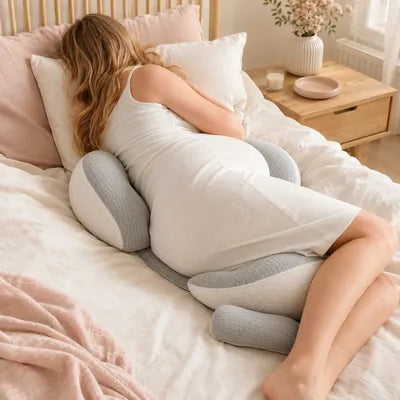
- Laid flat, along your body. One arm behind your back, one in front of you, the point down near your hips. This is the side sleeping position, and the one in our product photo.
- Laid flat, round your waist. The point behind you and the arms forward, so your forearms have somewhere to rest. This is the feeding position after the birth.
Six ways to use a V shaped pillow
1. Sitting up in bed to read or watch
Stand the V against the headboard with the point at the bottom and sit back into it. Your upper back rests in the gap and each arm sits behind a shoulder. If there is a gap at your lower back, slide an ordinary pillow under the point. A V suits this better than a stack of flat pillows: the arms wrap round you rather than just pushing straight back.
2. Propped up on heartburn nights
The NHS says that propping your head and shoulders up when you go to bed can stop stomach acid coming up while you sleep. Lay a normal pillow flat, then stand the V on it, point down, so your head and shoulders sit higher than your hips. It is the same position as reading, just lower. A V will not cure heartburn, but it is one of the easier ways to stay propped instead of sliding down the bed by 2am.
3. On your side, with the V along your body
This is the pregnancy position. Lie on your side with your head on your usual pillow. Lay the V flat beside you with the point down near your hips, one arm running up behind your back and the other in front of you, so you can rest your top arm on it and hook your top knee over the end. In later pregnancy the front arm can sit a little lower, under the bump.

The arm behind you is the part that matters. Tommy's gives exactly this tip for the last three months: put a pillow or pillows behind your back to encourage side sleeping. A V puts one there and another in front, joined, so neither drifts away during the night.
4. On your side or back, as a head pillow
Some people sleep with the point at the neck and the arms either side of the head, which holds the neck and shoulders. It sits higher than a normal pillow, so give it a few nights before you judge it. If your neck prefers your usual pillow, keep the V for sitting up and for position 3. From 28 weeks, Tommy's and the NHS advise going to sleep on your side rather than your back.
5. Feeding after the birth
Lay the V round your waist with the point behind you and the arms forward. Your forearms rest on the arms, and the point gives your lower back something to lean on. The NHS guidance on breastfeeding positions is short on this: use pillows or cushions if necessary. A V is not a dedicated nursing pillow, and it will not hold a baby at the right height on its own, but it takes the weight off your arms.
6. On the sofa or in an armchair
Point down behind you, exactly as in bed. On a sofa you can also lay one arm along the armrest and lean on it sideways. It is also a good home for it once the pregnancy is over.
Is a V pillow enough in pregnancy?
For a lot of the pregnancy, yes. If your problem is sitting up comfortably, heartburn at night or a top knee that needs somewhere to go, position 3 with a 73 by 34 cm V covers it, and it takes almost no room in the bed.
Where it runs out is the third trimester, if you need support all night from head to knees and you turn over a lot. A V holds your back and your top arm and knee. It does not reach your head and your knees at the same time, and every time you change sides you have to move it with you. At that stage we would rather sell you something longer than watch you fight a small pillow at 3am:
- the Full Body U (130 by 70 cm) if you have a double bed or bigger and turn over often,
- the Bump Wing if you share the bed and only need the bump and back held,
- the Body Bolster (about 122 cm) if you mainly want something long to hug.
If you are not sure which, pregnancy pillow shapes compared puts them side by side.
V pillow or U pillow: the real difference
People ask this as if one were a smaller version of the other. It is closer to say that a V is a U with the bottom cut off. Here is how ours compare, using the sizes on each product page.
| Pillow | Size | What it holds | Bed space | Best for |
|---|---|---|---|---|
| V Pillow | 73 x 34 cm | Back and top arm and knee on your side, or shoulders sitting up | Very little | Sitting up, heartburn nights, feeding, a small bed |
| Full Body U | 130 x 70 cm | Head, back, bump, hips and knees at once | About half a 135 cm double | All night support in the third trimester |
| Body Bolster | About 122 cm long | One area at a time: bump, chest or knees | Little width | Hugging, any bed size |
| Bump Wing | 64 to 78 x 36 cm | Bump in front, lower back behind | 36 cm of the bed's length | A shared double |
The short version: a U holds you, a V props you. If you mostly sit up, feed or need one arm of support behind your back, the V is the cheaper and more flexible choice. If you want to be held all night without moving anything, the U is the one.
What the NHS and Tommy's actually say
Neither names a brand or a pillow shape, and the NHS pages on pregnancy heartburn and on breastfeeding positions do not mention V pillows at all. What they do say is useful, so here it is word for word:
- NHS, heartburn in pregnancy: propping your head and shoulders up when you go to bed can stop stomach acid coming up while you sleep. Sleeping on your left side can also help.
- Tommy's, Sleep On Side: put a pillow or pillows behind your back to encourage side sleeping in the last three months. Tommy's also says you can go to sleep on either side, and that if you wake on your back you should simply roll back onto your side.
- NHS, breastfeeding positions: use pillows or cushions if necessary.
A V pillow is a comfort product, not a medical device. It does not treat back pain, pelvic pain or heartburn. If any pain worries you, your midwife or GP is the right person to ask, not a pillow shop.
Looking after a V pillow
Ours is 73 by 34 cm, filled with 100% virgin hollowfibre inside a polyester and cotton shell, and the manufacturer lists the care as sponge clean only. That shell does not zip off, so the practical answer is a V shaped pillowcase over it. They are sold separately, because a standard rectangular case will not fit the angle. Fibre fillings flatten a little overnight, and a shake along each arm in the morning helps it recover.

Questions people ask about V pillows
How do you use a V shaped pillow?
Turn the point to match the job. Point down and stood up behind you, it props your shoulders for reading or feeding. Laid flat along your body with the point near your hips, it gives you one arm behind your back and one in front to rest your top arm and knee on, which is the side sleeping position.
Which way up does a V pillow go?
There is no single right way up. Point down when you sit up against it, point near your hips when you lie on your side with it along your body, and point behind you when it goes round your waist for feeding.
What are V shaped pillows good for?
Sitting up in bed, staying propped on heartburn nights, side sleeping with something behind your back, and resting your arms while you feed. They also work well on a sofa.
Can you use a V pillow when pregnant?
Yes. Laid along your body, it puts a pillow behind your back, which is exactly the side sleeping tip Tommy's gives for the last three months, and a second arm in front for your top leg. In the third trimester, if you need head to knee support all night, a U shaped pillow does more.
How do you sleep with a V pillow on your side?
Keep your head on your normal pillow. Lay the V flat beside you, point down near your hips, with one arm behind your back and the other in front of you. Rest your top arm on the front arm and hook your top knee over its end.
What is the difference between a V shaped pillow and a U shaped pillow?
A U wraps all the way round you, from head to knees, on both sides at once. A V is open at the bottom, so it props one area at a time. A U holds you; a V props you. Ours are 130 by 70 cm and 73 by 34 cm.
Are V pillows good for back pain?
We will not tell you a pillow treats pain, because it does not. A V can make sitting up or lying on your side more comfortable. For back or pelvic pain in pregnancy, the NHS pelvic pain page and your midwife are the places to start.
Does the NHS recommend V shaped pillows?
Not by name. The NHS pages we checked on pregnancy heartburn and breastfeeding do not mention V pillows. They advise propping your head and shoulders up for heartburn and using pillows or cushions if necessary when feeding, and Tommy's advises a pillow behind your back for side sleeping.
Do you need a special pillowcase for a V pillow?
Yes, if you want it covered. A rectangular pillowcase will not fit the angle, so look for a V shaped case. Ours has a fixed shell that does not zip off, and the manufacturer lists it as sponge clean only.
Written by Serge, who runs Pregnancy Pillow UK. He is not a midwife, and nothing here is medical advice. The sleeping and feeding guidance quoted above comes from the NHS and Tommy's, and the sizes come from each product page. Last reviewed 3 October 2026.
The pillows on this page


Using a full body pillow instead? See how to use a pregnancy pillow, and for timing, when to start using one.