The short answer: between weeks 16 and 20, or sooner if your hips ache. That is when the bump begins to pull on the back and hips at night, and when lying flat on your back stops being comfortable.
But a week number is a weak answer, because it is not what actually decides it. The real answer is the night your usual sleeping position stops working. For some people that happens at twelve weeks and for others not until twenty four. Nothing goes wrong if you start earlier, and nothing is gained by holding out.
The rest of this page is what changes at each stage, the signs that it is time, and which shape to start with, which is not the biggest one.
The five signs it is time
Ignore the calendar and watch for these instead. Any one of them is reason enough.
- You wake up on your back. Not because that is dangerous in itself, but because it means nothing is holding your position, and from this point on it will keep happening.
- Your top hip aches in the morning. This is the most common one, and it is the easiest to fix. It is caused by your top leg dropping forward and rotating your pelvis while you sleep.
- You are stacking ordinary pillows and they keep sliding out. Two pillows do work. They just do not stay where you put them for eight hours.
- Turning over has become a manoeuvre. When changing sides means waking up properly rather than half rolling, sleep quality drops sharply.
- Heartburn at night. The NHS says propping your head and shoulders up can stop stomach acid coming up while you sleep, and a long pillow gives you something to build that against.
What changes at each stage
Weeks 1 to 12, the first trimester
You may not need anything yet: the discomfort at this stage is usually sickness and exhaustion rather than position. If your hips already ache, start now. There is no reason to wait and no advantage in waiting.
Weeks 13 to 27, the second trimester
This is a good time to start. The bump becomes heavy enough to pull on the lower back when you lie on your side, and lying on your back gets uncomfortable on its own. A long bolster is usually enough here, and it has the advantage of building the habit before you are desperate.
Weeks 28 to 40, the third trimester
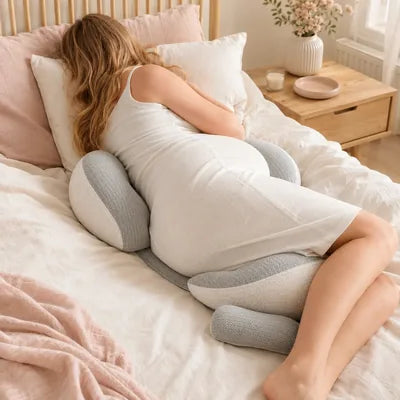
The change at 28 weeks is not just comfort. Tommy's and the NHS advise going to sleep on your side from 28 weeks, so the pillow stops being about comfort and starts being about holding a position all night. This is the stage where a bolster may stop being enough and a full U or a two piece wing makes sense, because those support you from behind as well as in front and make drifting onto your back less likely.
It is also the stage where getting up to rearrange a pillow costs you the most, because getting back to sleep takes longer. Whatever you use now should be something you can turn over inside without sitting up.
After the birth, the fourth trimester
A bolster can become a feeding support.
What the guidance actually says about side sleeping
This gets repeated badly online, so here it is plainly. The advice from Tommy's, which the NHS echoes, is to go to sleep on your side from 28 weeks, including for naps. It is about the position you fall asleep in, because that is the one you spend most of the night in.
It is worth knowing how common the pain that sends people looking for a pillow actually is, because it explains why we will not hand you a week number. Tommy�s puts it at around 1 in 5 women and birthing people having pelvic pain in pregnancy, and states plainly that you can get it at any time in pregnancy. There is no week at which it politely begins, so there is no week at which a pillow politely becomes useful.
Two things that often get added and should not be. First, it does not have to be the left side. Either side is fine. Second, waking up on your back is not something to panic about. If it happens, you simply turn back onto your side and go back to sleep.
A pregnancy pillow is not medical equipment and it does not make anything safe by itself. What it does is make a side position comfortable enough that you stay in it, which is a practical problem rather than a clinical one.
If you have pain that is getting worse, pain that wakes you, any bleeding, or reduced movements, that is a call to your midwife rather than a shopping decision.
Which shape to start with
It is tempting to buy the biggest one first. We would not.
Start with a long bolster. It costs �12.49, it takes the least room in a bed you share, and it does one job well, which is holding your top leg level with your hip so your pelvis stops rotating. If it turns out to be all you need, you have spent about half what a full U costs.
If what bothers you most is heartburn at night or sitting up to feed, a smaller V pillow can be enough on its own: see how to use a V shaped pillow.
Move up when, and only when, you notice you are ending up on your back. That is the thing a bolster cannot fix, because there is nothing behind you. At that point the choice is a full U if you sleep alone or have a king, and a two piece wing if you share a standard 135 cm double, because a U also runs 130 cm down the bed, where a wing covers 36 cm.
If you want the measurements for all of them before you decide, they are on our pregnancy pillow shapes page, and the ranking by situation is on our guide to the best pregnancy pillow in the UK.
Two things worth knowing before you buy anything
Give it a fortnight before you judge it
Almost nobody sleeps better on the first night with a new shape in the bed. It takes about two weeks to stop noticing it is there. This is the single most common reason a pillow gets returned in week one when it would have worked in week three, and it is why a return window measured in weeks matters more than the price. Ours is 90 nights.
Measure the bed first
A UK single is 90 cm across, a standard double is 135 cm and a king is 150 cm. Thirty seconds with a tape measure prevents most disappointments, because the shape that suits you and the shape that fits your bed are not always the same shape, and the one that annoys your partner every night is the one that ends up in a cupboard.
Already at 32 weeks and still without one?
People ask whether it is worth buying at this point, with weeks rather than months left. It is, for two reasons that have nothing to do with us wanting to sell one.
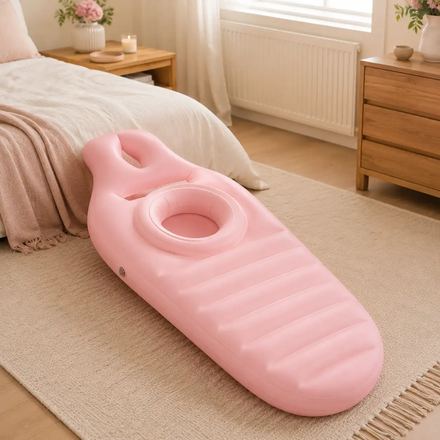
The first is that the last eight weeks are the hardest to sleep through, so the weeks you would be buying are the ones where it makes the most difference per night. The second is that this is precisely the stretch where you use it beyond the birth. If you are buying at 32 weeks, buy the shape that also works for feeding and for recovery, which means a bolster or a full U rather than the inflatable lounger.
One adjustment if you are starting this late: skip the gradual approach and go straight to whichever shape holds you from behind as well as in front. There is no time left to build up, and rolling onto your back is the problem you are trying to solve by now.
Reasons to start earlier
The weeks 16 to 20 figure is only a guide, and a guide does not describe everyone. Start sooner if any of these apply to you.
- You are expecting twins. The bump is bigger sooner, so the point at which side lying needs supporting arrives several weeks earlier than it would otherwise.
- You already had hip, back or pelvic pain before you were pregnant. A pillow is not a treatment for that, but there is no reason to spend a trimester without the support you would end up using anyway.
- You are a natural front sleeper. Front sleeping becomes impossible fairly early, and the transition to sleeping on your side is much easier if you make it before you are forced to. If it is lying on your front by day that you miss, a front lying pregnancy lounger is made for short daytime rests, not for sleep.
- This is not your first pregnancy. Bumps tend to show earlier and the symptoms tend to arrive earlier, so whatever week it started last time is a better guide than any average.
None of these are reasons to worry. They are just reasons that the calendar answer will be wrong for you, and the signs above will be a better guide than a week number.
Questions people ask about timing
When should you start using a pregnancy pillow?
A good time to start is between weeks 16 and 20. That is when the bump starts to pull on the back and hips at night and when lying flat on your back stops being comfortable. There is no medical week to wait for, so the honest answer is the night your usual sleeping position stops working. For some people that is week 12 and for others it is week 24.
Is it too early to use a pregnancy pillow in the first trimester?
No. There is nothing to be gained by waiting and nothing about a pregnancy pillow that makes it unsuitable early on. Some start in the first trimester because of sore hips or simply because they already sleep with a pillow between their knees. Starting early also builds the habit before you are uncomfortable enough to be woken by it.
Do I need a pregnancy pillow at 28 weeks?
Not need, but by 28 weeks the bump is heavy, and a side position is harder to hold for a whole night without support. Tommy's and the NHS advise going to sleep on your side from 28 weeks, and a pillow is the simplest way to make a side position stay comfortable for a whole night rather than for an hour.
Which pregnancy pillow should I start with?
A long bolster is the sensible first purchase. It is one of the cheapest shapes, it takes the least room in a shared bed, and it does the main job of holding your top leg level with your hip. If you find in the third trimester that you keep rolling onto your back, that is the point to move up to a full U or a two piece wing, which support you from behind as well.
How long can you use a pregnancy pillow for?
For the whole pregnancy and well past it. A bolster becomes a back prop while you feed, and stays a body pillow long after.
What month should you get a pregnancy pillow?
The fourth or fifth month, weeks 16 to 20, is a sensible time to buy one. That is when the bump starts pulling on the hips and lower back at night. There is no wrong month. Buying earlier builds the side sleeping habit before you need it, and buying in the third trimester is the stretch where it makes the most difference per night.
Do doctors recommend pregnancy pillows?
Not as a product. The NHS and Tommy�s advise sleeping on your side from 28 weeks, and neither names a brand or a shape. A pregnancy pillow is a comfort aid that makes that position easier to hold through the night. It is not a medical device and it does not treat anything. If you have pain that worries you, ask your midwife rather than buying a cushion.
These pages are written and kept up to date by Serge, who runs Pregnancy Pillow UK. He is not a midwife, and nothing here is medical advice. The side sleeping guidance quoted above comes from Tommy's and the NHS. If anything about your pregnancy worries you, speak to your midwife rather than to a shop. Last reviewed 20 September 2026.
Shop all shapes


Once you have one, the position matters more than the week you started. See how to lie in a pregnancy pillow.